
Finding reliable collagen solutions for ligament health often feels confusing, but research shows over 85 percent of American women experience joint discomfort as they age. Staying active is a priority for many women, yet ligament injuries can undermine both confidence and mobility. Understanding how specialized forms of collagen work for ligament strength empowers you to make smarter decisions that truly support your joints and an active lifestyle.
Table of Contents
- What Is Collagen for Ligaments?
- Types of Collagen and Their Roles
- How Collagen Supports Ligament Health
- Supplementation Methods and Effectiveness
- Risks, Limitations, and Alternatives
Key Takeaways
| Point | Details |
|---|---|
| Collagen’s Structural Role | Collagen is essential for ligament strength and elasticity, providing the primary structural support needed to withstand mechanical stress. |
| Types of Collagen | Type I and Type III collagen are key for ligament health, where Type I offers strength and Type III provides elasticity. |
| Supplementation Insights | Collagen supplementation can enhance ligament health, especially when paired with vitamin C for better absorption. |
| Holistic Approach | A comprehensive strategy, including nutrition and exercise, is crucial for optimizing ligament health and individual metabolic responses. |
What Is Collagen for Ligaments?
Collagen is the fundamental structural protein that serves as the essential building block for ligament health and function. Ligament strength and integrity fundamentally depend on this remarkable protein’s unique molecular structure and composition.
At its core, collagen represents a complex protein comprised of amino acids arranged in a distinctive triple helix formation. This intricate design enables collagen to provide exceptional tensile strength and elasticity to connective tissues. Structural protein of connective tissue enables ligaments to withstand significant mechanical stress and tension without compromising their fundamental structure.
The amino acid profile of collagen is particularly noteworthy. Key amino acids like glycine and proline play critical roles in ligament remodeling and maintenance. These specialized amino acids contribute to:
- Maintaining ligament elasticity
- Supporting tissue repair mechanisms
- Enhancing overall connective tissue resilience
- Protecting against potential injury and degradation
Understanding collagen’s role in ligament function helps individuals recognize its significance beyond mere structural support. Collagen acts as a dynamic protein that continuously supports joint mobility, flexibility, and overall musculoskeletal health.
Pro tip: Consider consulting a healthcare professional about targeted nutrition strategies that might support your body’s natural collagen production and ligament health.
Types of Collagen and Their Roles
Collagen is not a singular protein, but a complex family with multiple variants that serve unique functions in the human body. Multiple collagen types exist, each playing a specialized role in supporting different tissue structures and mechanical properties.
The most prevalent collagen types relevant to ligament health include Type I and Type III, which are critical for maintaining structural integrity and flexibility. Ligament mechanical properties demonstrate how these specific collagen types work synergistically to provide strength and resilience.
Here’s a detailed breakdown of the primary collagen types impacting ligament function:
-
Type I Collagen
- Comprises approximately 90% of total body collagen
- Primary structural protein in skin, bones, tendons, and ligaments
- Provides exceptional tensile strength and stability
-
Type III Collagen
- Found in muscles and organ tissues
- Contributes to ligament elasticity
- Supports complementary mechanical behavior
-
Type II Collagen
- Predominantly found in cartilage
- Less directly involved in ligament structure
- Supports joint cushioning and overall joint health
Understanding these collagen types helps individuals recognize the complex biomechanical support system within our connective tissues. Each type contributes uniquely to maintaining mobility, preventing injuries, and supporting overall musculoskeletal wellness.
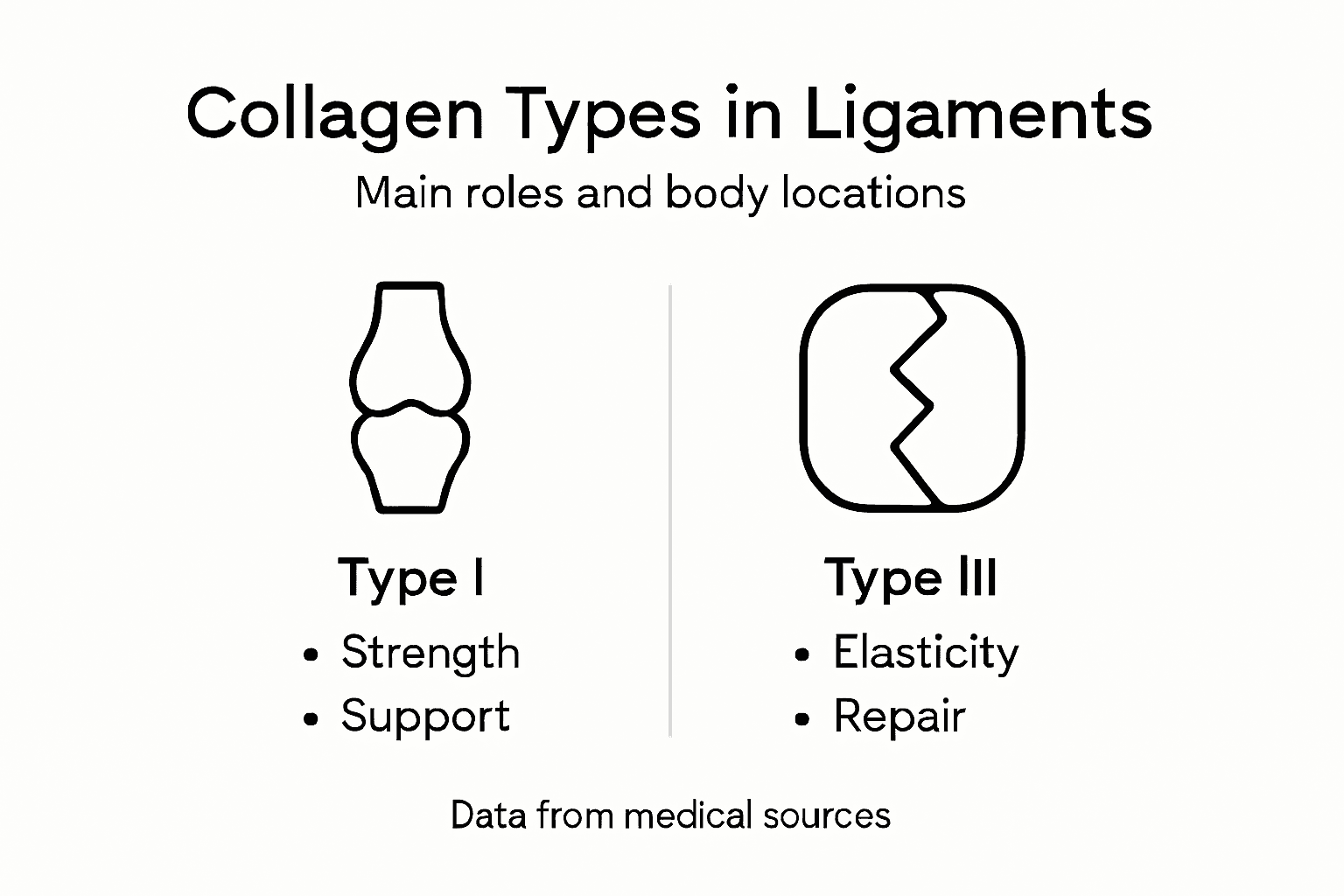
Here’s a quick overview of major collagen types and their impact on different tissues:
| Collagen Type | Main Locations | Ligament Role | Unique Characteristic |
|---|---|---|---|
| Type I | Skin, ligaments, bone | Provides strength | Most abundant type |
| Type II | Cartilage | Indirect support | Cushions joints |
| Type III | Vessels, muscles, organs | Adds elasticity | Often found with Type I |
Pro tip: Consider consulting a nutritionist about targeted supplements that might support your body’s natural production of Type I and Type III collagen for optimal ligament health.
How Collagen Supports Ligament Health
Collagen plays a critical role in maintaining ligament health by serving as the primary structural framework that enables tissue resilience and functionality. Mechanical strength of ligaments depends on this protein’s unique ability to create a robust scaffolding that absorbs tension and resists potential damage.

The protein’s extraordinary capacity for continuous tissue remodeling ensures that ligaments remain flexible and strong. Ligament repair processes demonstrate how collagen actively participates in maintaining and recovering tissue integrity, providing essential amino acids that support ongoing cellular regeneration and structural maintenance.
Key mechanisms of collagen’s support for ligament health include:
- Tension Absorption: Creating a resilient matrix that distributes mechanical stress
- Structural Integrity: Maintaining the fundamental framework of ligament tissues
- Repair Facilitation: Supplying critical amino acids for tissue recovery
- Elasticity Maintenance: Ensuring ligaments can stretch and return to original position
Understanding collagen’s multifaceted role helps individuals appreciate how this protein serves as more than just a structural component. It acts as a dynamic biological resource that actively contributes to joint mobility, injury prevention, and long-term musculoskeletal wellness.
Pro tip: Consider incorporating protein-rich foods and collagen-supporting nutrients into your diet to naturally enhance your body’s ligament maintenance processes.
Supplementation Methods and Effectiveness
Collagen supplementation offers a strategic approach to supporting ligament health through targeted nutritional interventions. Hydrolyzed collagen peptides represent an advanced method of delivering critical amino acids directly to connective tissue systems, enabling more efficient absorption and utilization.
The effectiveness of collagen supplementation hinges on several key factors, including molecular weight, preparation method, and complementary nutrient intake. Collagen bioavailability strategies suggest that combining collagen with vitamin C can significantly enhance amino acid absorption and support natural collagen synthesis processes.
Different supplementation approaches include:
-
Hydrolyzed Collagen Peptides
- Lower molecular weight for enhanced absorption
- Rapid integration into connective tissues
- Supports muscle recovery and tissue repair
-
Gelatin Supplements
- Traditional collagen supplementation method
- Rich in glycine and proline amino acids
- Supports overall connective tissue health
-
Vitamin C Enhanced Formulations
- Improves collagen synthesis efficiency
- Supports amino acid conversion
- Enhances overall supplementation effectiveness
Understanding the nuanced approach to collagen supplementation empowers individuals to make informed choices about supporting their ligament health and overall musculoskeletal wellness.
This table summarizes popular collagen supplementation methods and their notable features:
| Method | Absorption Speed | Nutrient Pairing | Typical Use Case |
|---|---|---|---|
| Hydrolyzed Peptides | Rapid | Vitamin C | Active recovery support |
| Gelatin Supplements | Moderate | Balanced diet | General tissue health |
| Vitamin C Enhanced | Fast | With collagen | Maximizing synthesis |
Pro tip: Consult with a healthcare professional to determine the most appropriate collagen supplementation strategy tailored to your specific physiological needs and activity levels.
Risks, Limitations, and Alternatives
Collagen supplementation presents a nuanced approach to ligament health with several important considerations to evaluate. Variability in collagen effectiveness highlights the critical need for personalized assessment and understanding of potential limitations and individual metabolic differences.
Supplementation safety profiles demonstrate generally good tolerance, but inconsistent scientific evidence suggests that results can vary significantly across different individuals. Understanding these limitations is crucial for making informed decisions about nutritional strategies.
Key risks and alternative strategies include:
-
Supplementation Limitations
- Inconsistent scientific evidence
- Variability in individual metabolic responses
- Potential minimal impact for some individuals
-
Alternative Ligament Support Strategies
- Targeted resistance training
- Physical therapy interventions
- Comprehensive nutritional support
- Vitamin C supplementation
- Amino acid-rich diet
- Zinc and other supporting nutrients
-
Holistic Approach Considerations
- Combine nutritional strategies
- Focus on overall musculoskeletal health
- Individual metabolic assessment
Recognizing that no single approach guarantees optimal results, individuals should adopt a comprehensive strategy that addresses multiple aspects of ligament health and personal physiological needs.
Pro tip: Consult a healthcare professional to develop a personalized approach that integrates supplementation, nutrition, and targeted exercise for comprehensive ligament support.
Strengthen Your Ligaments Through Targeted Collagen Support
If you are looking to boost your ligament strength and mobility while reducing injury risk collagen plays a vital role as outlined in this article. The challenges of maintaining ligament elasticity and promoting effective repair require access to high-quality collagen peptides combined with supporting nutrients like vitamin C. These elements are key to rebuilding tough connective tissues that keep you moving confidently.

Discover peptide-based wellness solutions at Emily Sanders Lifestyle that focus on optimizing collagen absorption and synthesis. Our offerings emphasize research-driven approaches tailored to enhance ligament health and musculoskeletal resilience. Take the next step to support your body’s natural collagen production today by visiting Emily Sanders Lifestyle and exploring how peptide supplementation can elevate your joint mobility and long-term vitality.
Frequently Asked Questions
What is the role of collagen in ligament health?
Collagen is a fundamental structural protein that provides tensile strength and elasticity to ligaments, enabling them to withstand mechanical stress and contribute to overall joint mobility and resilience.
What types of collagen are most important for ligaments?
The most relevant types of collagen for ligaments are Type I and Type III. Type I provides strength and stability, while Type III contributes to elasticity and complements the biomechanical properties of ligaments.
How can collagen supplementation benefit ligament health?
Collagen supplementation can enhance ligament health by supplying critical amino acids that support tissue repair, promote flexibility, and maintain structural integrity, ultimately boosting mobility and reducing injury risk.
Are there any risks associated with collagen supplementation?
While collagen supplementation is generally safe, its effectiveness can vary among individuals. Factors such as metabolic responses and overall diet can impact results, so it’s advisable to consult a healthcare professional for personalized guidance.
Recommended
- Comprehensive collagen peptide reviews – 7 Top Picks 2026 – EMILY SANDERS LIFESTYLE
- 7 Essential Things Women Need to Know About GHK-Cu Peptide – EMILY SANDERS LIFESTYLE
- Recovery Peptide: Boosting Skin Repair and Wellness – EMILY SANDERS LIFESTYLE
- Glow Peptide: Pathway to Ageless, Radiant Skin Health – EMILY SANDERS LIFESTYLE
- What Is Vegan Collagen? Benefits For Skin Health
0 comments